Supportive Sisterhood Program Graduation
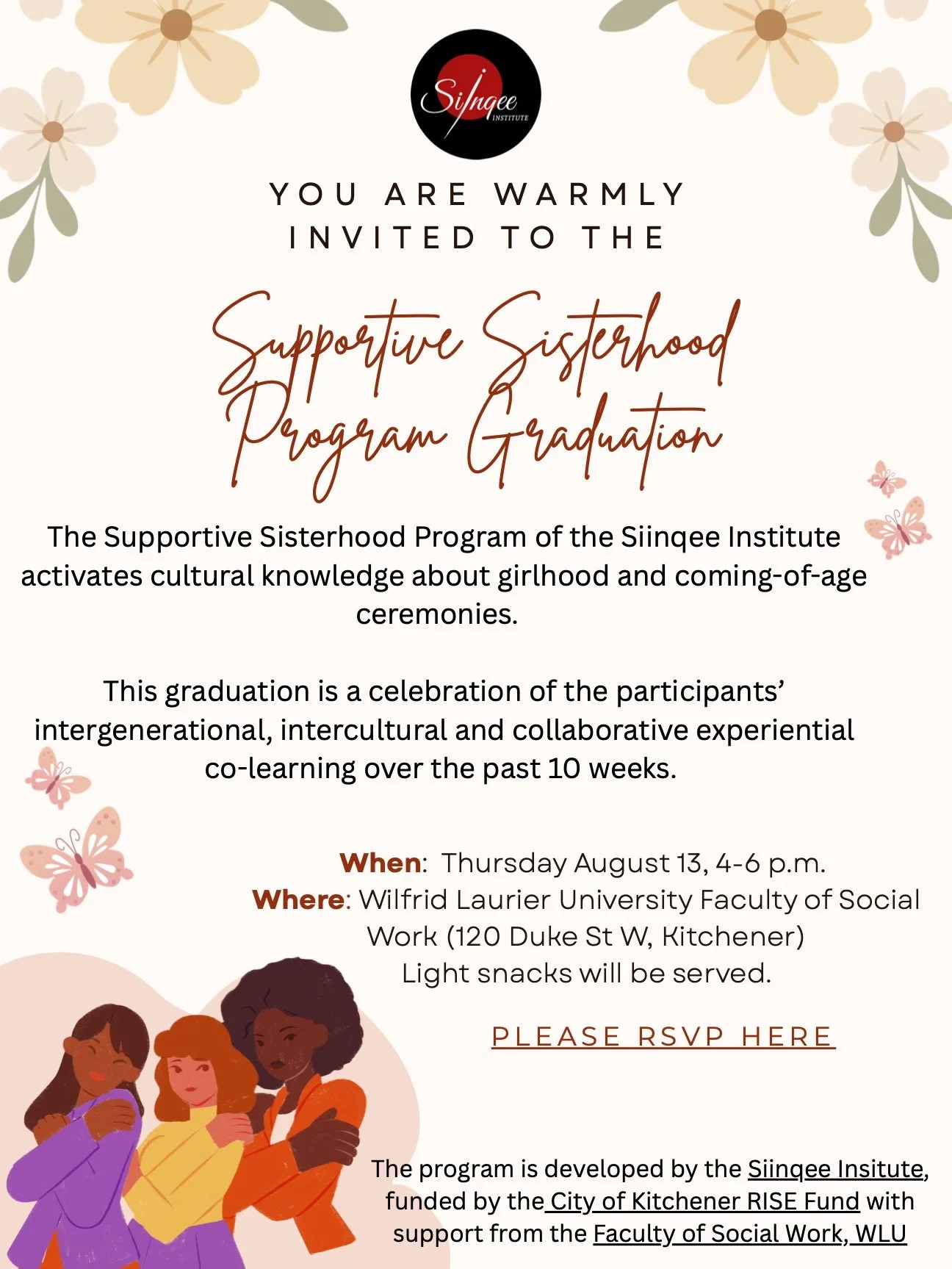
It is amazing how quickly time flies by! Please help us celebrate an incredible group of young women and girls in our upcoming graduation ceremony of the Supportive Sisterhood Program in Kitchener, Canada!
Congratulations to the graduates!!!!!!
Supportive Sisterhood Program
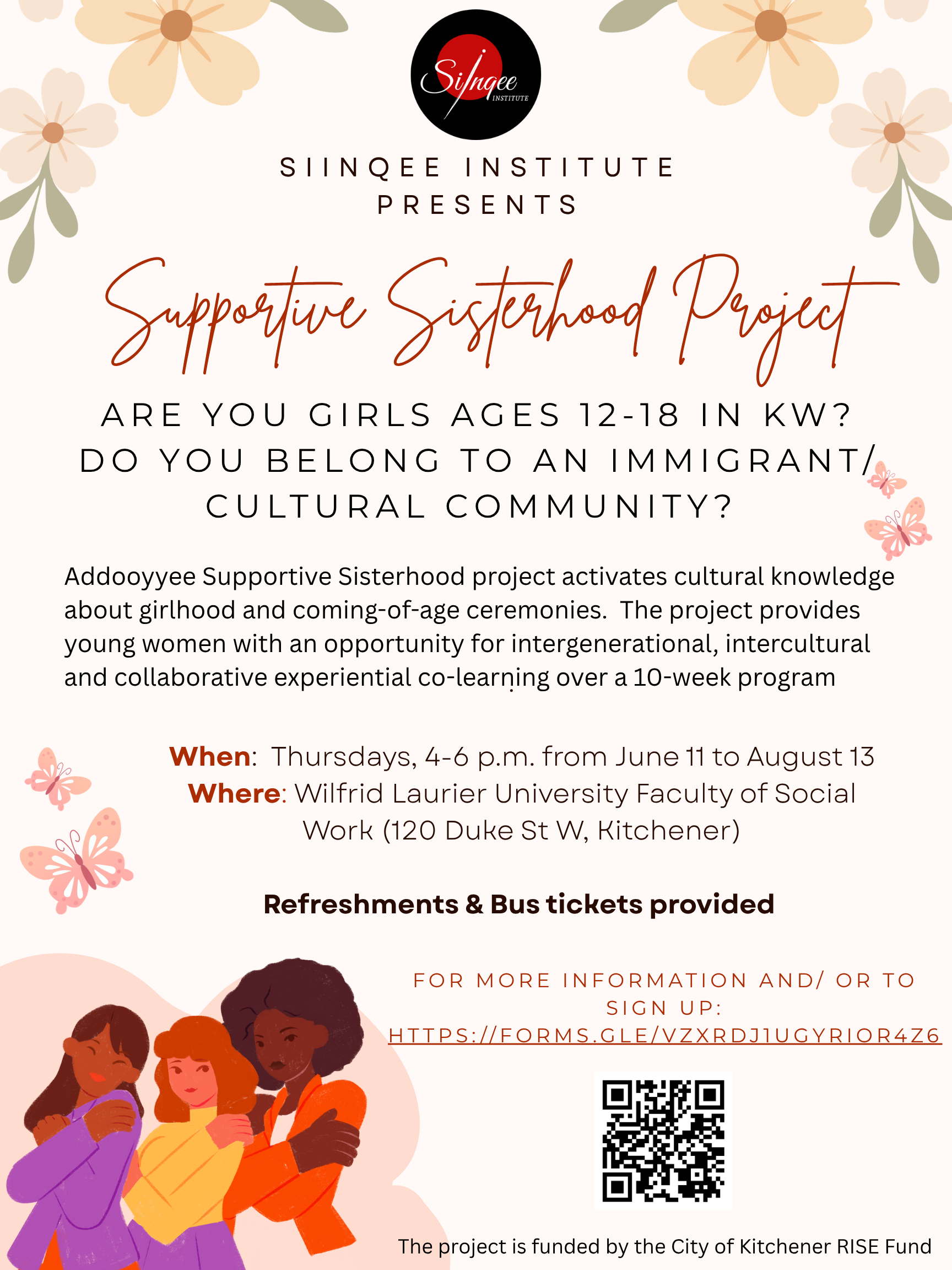
The Supportive Sisterhood Program is a 10-week immersive program for young women and girls ages 12-18 from migrant and cultural backgrounds to learn and exchange knowledge on the ways different cultures celebrate the special period from adolescence to adulthood.
The project aims to empower young women through intergenerational, intercultural and collaborative learning experiences. You will have an opportunity to learn from Elders, peers and facilitators about diverse cultural practices of girlhood and coming-of-age. The session will end with a celebration "graduation" of your development of a culturally-affirming sense of belonging, solidarity and sisterhood.
The sessions will take place every Thursday, from 4-6 p.m and will alternate between zoom and in-person. The in-person session will take place at the Wilfrid Laurier University Faculty of Social Work campus (120 Duke St. West, Kitchener). Refreshments and bus tickets are provided!
We are grateful that this Supportive Sisterhood Program is partially funded by the City of Kitchener’s RISE project grant. This project is situated in the City of Kitchener which is on the Traditional Territory of the Chonnonton, Anishinaabeg, and Haudenosaunee Peoples.
Please see our flyer with the registration link for more information. For further inquiries, please don't hesitate to reach out to the organizing team at siinqeeinstitute@gmail.com.


The Global Sisterhood Podcast
The Global Sisterhood Podcast is a project developed by Emma Shippey and Anh Ngo (Faculty of Social Work, WLU) in partnership with the Siinqee Institute. The podcast is a series of stories told through conversation and dialogue with people who are actively working and researching in the areas of gender justice and migration alongside diasporic communities. Listen along to the first season of the podcast, as Emma discusses themes of solidarity, community, and healing with members of the Siinqee Institute.
Emma Shippey is a social worker, community artist, and musician who is passionate about arts-based practices for storytelling and community engagement. Anh Ngo is a scholar in the areas of social work and critical refugee and migration studies.
Episode 1 Part 1: Knowledge Under Conditions of Rupture with Kuwee Kumsa
Emma is joined by Kuwee Kumsa, a scholar from Oromia, Ethiopia, whose work centers Oromo women’s experiences, feminist thought, and the intersections of culture, power, and education. They discuss concepts of gratitude, knowledge as a form of resistance, and Siinqee feminism. This is Part 1 of a 2-part podcast episode.
For further reading on the concepts discussed by Kuwee, please explore these publications:
· Kumsa, M. K. (2022). Weaving academic home: Metaphor, insurgent culture, and transnational Indigeneity. Qualitative Inquiry, 28 (6), 618 – 624. https://journals.sagepub.com/doi/10.1177/10778004211002759
· Kumsa, M.K. (2016). Thinking about Research, Qualitative Social Work: Research and Practice, 15: 1-8, 2016
· Kumsa, M. K. (2007). The Meaning of Displacement and the Displacement of Meaning. In A. Asgharzadeh, E. Lawson, K. U. Oka, & A. Wahab (Eds.) Diasporic Ruptures: Globality, migrancy, and expressions of identity (Volume II, pp. 95-110). Rotterdam: Sense Publishers.
Episode 1 Part 2: Diaspora, Sisterhood, Future Generations with Kuwee Kumsa
Emma is joined by Kuwee Kumsa, a scholar from Oromia, Ethiopia, whose work centers Oromo women’s experiences, feminist thought, and the intersections of culture, power, and education. They continue the discussion from Part 1 and delve further into Global feminism, international advocacy, diaspora responsibilities for knowledge keeping and transmission, and the development of the Siinqee Institute. This is Part 2 of a 2-part podcast episode.
For further reading on the concepts discussed by Kuwee, please explore these publications:
· Kumsa, M. K. (2013). Songs of Exile: Singing the Past into the Future. Kitchener, Canada: Duudhaa Publishing. Available on the Siinqee Institute website at: https://siinqeeinstitute.org/songs-of-exile
· Kumsa, M. K. (2007/2011). A Resettlement Story of Unsettlement: Transformative Practices of Taking It Personally. In D. Baines (Ed.), Doing anti-Oppressive Practice: Social Justice Social Work (Second Edition), pp. 229-248. Halifax and Winnipeg: Fernwood Publishing.
· Kumsa, M. K. (2010). Wounds of the Gut, Wounds of the Soul: Youth Violence and Community Healing among Oromos in Toronto. Canadian Social Work Journal, 12 (1), 123-130.
Episode 2: Community with Peri Klemm and Rufo Juro
Emma is joined by Peri Klemm, an African art historian and professor whose work focuses on the rich artistic traditions of Oromia, with particular attention to identity, dress, and the body, and Rufo Jiru, a chemist, Oromo women’s advocate, founder of Jara and Jiru Foundation. Collectively, they discuss diaspora, cultural memory and practices as well as women’s community resistance and collective action.
For further exploration on the topics, please click on the links to view the documentary, The Siinqee Sisterhood: A Women's Ateetee Ritual in Arsi, Oromia, as well as the recorded film screening and panel discussion featured at the Siinqee Institute’s International Women’s Day webinar.
Episode 3: Healing with Aga Ruda and Chizuru Nobe-Ghelani
Emma is joined by Aga Ruda who is a social worker and community advocate, and Chizuru Nobe-Ghelani who is a scholar focused on health and wellbeing with marginalized communities. Collectively, they discuss decolonial wellbeing, earth-based healing, connections to ancestral lands and cultures, and the work of storytelling in wellness promotion.
For additional viewing and learning, please explore the following resources:
· https://globalhealth.harvard.edu/news-reimagining-mental-health-through-indigenous-worldviews/
· https://www.pbs.org/show/mysteries-mental-illness/collections/decolonizing-mental-health/
The Siinqee Sisterhood: A Women's Ateetee Ritual in Arsi, Oromia Film Screening and Discussion
This post brings together the film The Siinqee Sisterhood: A Women's Ateetee Ritual in Arsi, Oromia and the live Zoom discussion that followed its screening. The documentary highlights the cultural significance of the Ateetee ritual and the Siinqee sisterhood in promoting relationality, solidarity, equity, and justice among Oromo women, while the discussion offers deeper reflections from the filmmaker and participants on the meaning, challenges, and future of these traditions in both the homeland and the diaspora. Together, they provide a powerful exploration of cultural resilience, community, and the importance of preserving Indigenous knowledge systems.
Reclaiming connection, solidarity, equity and justice to empower all women
We at the Siinqee Institute are a network of Individuals and small groups coming together from across different social, cultural, political, spiritual and geographical boundaries. Our shared dream is to reclaim the three basic siinqee principles of connection, solidarity, and equity and justice to empower women and facilitate engaged vibrant communities in sustainable environments.
Knowledge Mobilization
Mobilizing knowledge is creating ways of moving research into communities, rescuing knowledge that collects dust on library shelves. It is how communities grab knowledge off of those shelves and make it walk into communities. It is how they make it their own, make it tell their stories, be their voice, cry with them, laugh with them, sing and dance with them.


Contact
Feel free to contact us with any inquiries.
Email
siinqeeinstitute@gmail.com