Our IWD Webinar 2025 recording is ready for viewing!
Accompanying the recording is a thoughtful summary and reflection of the event by Rachel Robinson, local community builder and MSW candidate:
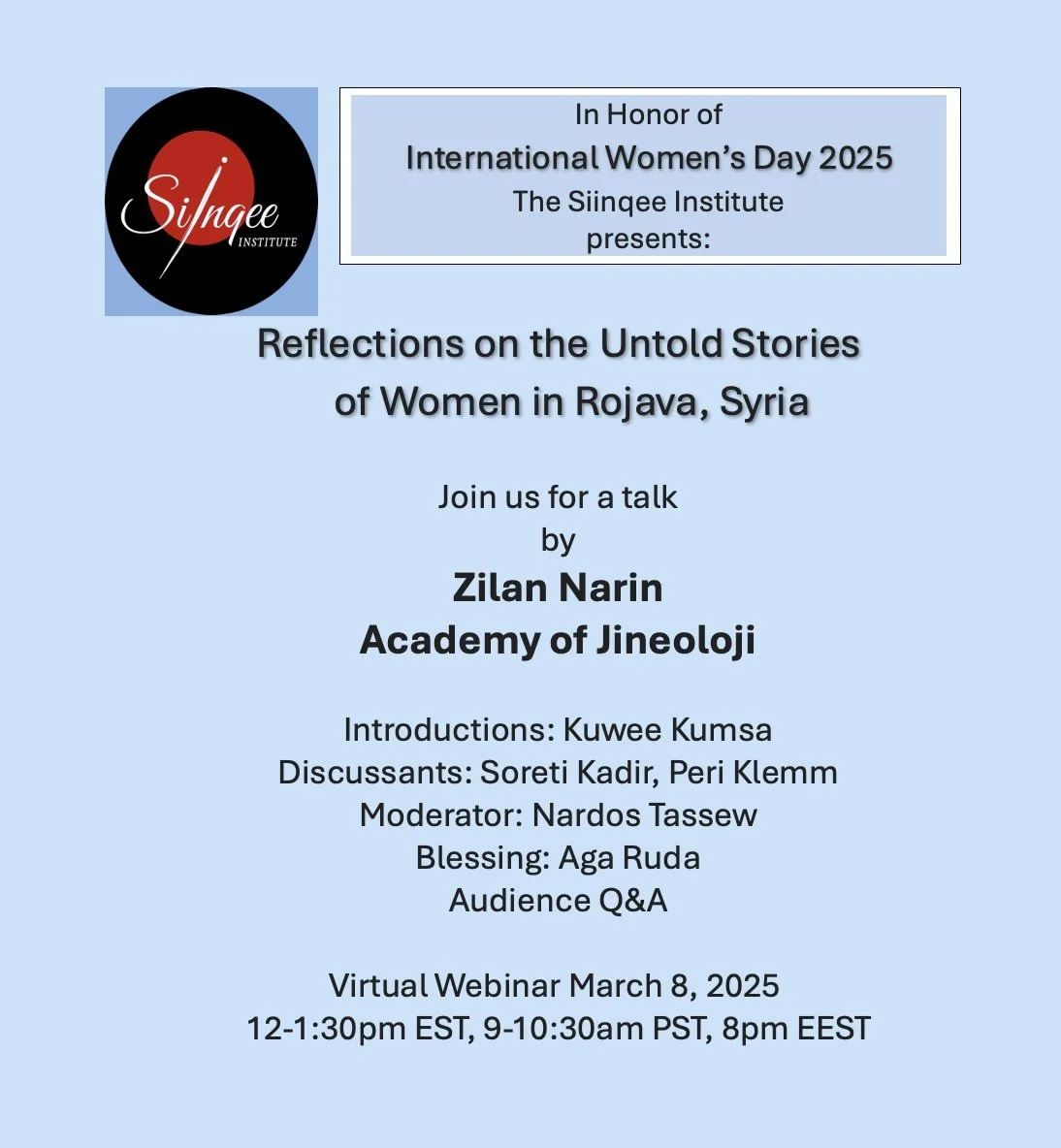
On International Women’s Day, the Siinqee Institute hosted a powerful webinar titled "Reflections on the Untold Stories of Women in Rojava, Syria," which illuminated the ongoing struggles of Kurdish women in their fight for liberation, justice, and recognition. The discussion was framed by a profoundly moving blessing offered by Aga Ruda, Board Member of Siinqee Institute, in her language, grounding the space in a spiritual and cultural foundation that honoured the voices of women who have been silenced.
One of the most pressing themes throughout the webinar was the reality that women’s voices are not being heard when it comes to the current conditions in Syria. The risks for women remain extraordinarily high, as they face oppression not only from patriarchal systems but also through the colonization of Kurdistan itself. Compassion and the feeling of the struggle for democracy is an everyday battle was felt, with women at the forefront despite the violence and suppression they endure.
A powerful video was shared to highlight the role of song and women's bodies in liberation and restorative justice. The embodied experience of oppression and resistance was acknowledged, emphasizing how cultural expressions like song become acts of resilience and defiance against erasure. This perspective resonated deeply with broader global struggles for women's rights, reinforcing the idea that decolonization is not only a political movement but also a spiritual and cultural reclamation.
The webinar also highlighted the importance of breaking the silence and utilizing the spaces we occupy to raise awareness, generate empathy, and advocate for tangible action. The call to enforce governmental accountability in response to crimes against humanity was clear: women must continue to push against systemic violence through collective advocacy. Moreover, the discussion pointed to the necessity of working together beyond the constraints of state and political domination, reclaiming power through grassroots organizing and solidarity.
The struggle for democracy in Northern Syria is deeply tied to global patterns of state oppression, political instability, and gendered violence. While the Rojava region has built a grassroots democratic system emphasizing women’s leadership and self-governance, it remains under constant attack from state forces, including Turkey’s military aggression and the broader instability in the region. This fight for self-determination, particularly by women, challenges the dominant structures of power that seek to erase alternative governance models.
In North America, we see different but interconnected struggles for democracy and justice. In both Canada and the USA, women—particularly Indigenous, Black, and racialized women—continue to fight for sovereignty, recognition, and protection from systemic violence. The ongoing crisis of Missing and Murdered Indigenous Women and Girls (MMIWG) in Canada and the USA echoes the silencing and endangerment of women in Northern Syria. State inaction and complicity in gendered violence remain a global issue, making it crucial to lift these stories and demand accountability.
Moreover, as democratic structures in North America face rising threats from authoritarianism, political polarization, and corporate interests, the resistance in Rojava serves as a reminder that democracy is not a given—it must be actively fought for and protected. Just as Kurdish women are resisting not only patriarchy but also colonial control over their land, many in Canada and the USA are pushing back against the erosion of rights, including attacks on reproductive justice, Indigenous sovereignty, and racial justice movements.
The webinar’s emphasis on action—breaking the silence, using our circles to raise awareness, and advocating for justice—resonates deeply in this political moment. The struggles of women in Rojava are not distant issues; they are reflections of broader systems of oppression that impact women globally. Whether through challenging state violence, advocating for community-led governance, or ensuring that women's voices remain central in the fight for justice, the connections between Northern Syria and North America remind us that the work of liberation is interconnected.
This webinar was a much needed reminder that the struggles of Kurdish women are not isolated; they reflect a global pattern of patriarchal and colonial violence against women. Their resilience, however, serves as both an inspiration and a call to action for those of us in the diaspora. As women continue to be marginalized across the world, lifting and amplifying their knowledges becomes an act of resistance against historical and contemporary erasure.
One of the key takeaways for me was the reminder that advocacy does not only happen in large political spaces—it occurs in the everyday circles we move through. Whether through conversations, community organizing, or academic work, we must center these voices and push for justice. The emphasis on song and embodiment as part of women’s liberation also struck me as particularly meaningful, reinforcing that healing and resistance are interconnected.
Ultimately, this webinar expressed the urgency of solidarity with women in Rojava and beyond. By breaking the silence, holding governments accountable, and strengthening support networks, we contribute to a broader movement that transcends borders. The struggle for justice is ongoing, but through collective action and the lifting of women’s knowledges, we continue to carve a path toward liberation.
By: Rachel Robinson
International Women’s Day 2025
IWD 2025 Tribute to Bonnie Holcomb
The Siinqee Institute pays tribute to Bonnie Holcomb (Qabbanee) for the 2025 International Women’s History Month
Credits: Siinqee women: Aagaa Ruudaa, Agamtii Botcho, Dammee Boro, Kuwee Kumsaa, Rahel Lamuu. Narrators: Dr. Peri M. Klemm, Marole Jote. Video recorded by: Yohannes Kumsaa.
International Women’s Month tribute to all eldest sisters everywhere.
As we continue the celebration of International Women's Month, Siinqee Institute board member Anh Ngo pays tribute to all eldest sisters in migrant households and in particular her own eldest sister.
International Women’s Month Tribute to the Siinqee women of Oromia and transnationally
The Board of the Siinqee Institute pays tribute to the Siinqee women of Oromia and transnationally. The principles upheld by the Siinqee women greatly informs and shapes the principles of the Siinqee Institute. In this tribute, Board member Peri Klemm pays homage to the wisdom and knowledge shared and passed on from incredible women in the local and global diasporas.
International Women’s Month Tribute to the women who raised us
We are held up by countless women in our lifetimes, some loudly leading at the forefront, some who’s quiet strength serves as the bedrock and foundation of our lives. For this month, Siinqee Institute Board member Chizuru Nobe-Ghelani honours her “Baachan”, her grandmother for her quiet strength and her teachings of love and curiosity for the natural world.
International Women’s Day Tribute to Aisha Ahmed Siraj and the women who shaped her:
As the world celebrates its women on the occasion of the 2025 International Women’s Day, the Siinqee Institute would like to pay tribute to Ayisha Ahmed Siraj and the strong Oromo women who lovingly shaped her into the strong woman she is today.
We honour Ayisha for her passionate love of her foremothers’ siinqee cultural heritage.
We praise her for her unflinching commitment to nurturing it and making it thrive in the diaspora, far away from her homeland.
We thank Ayisha for being a positive example, for inspiring many to embrace their cultural heritage, and for her invaluable contributions to developing it further.
Leellifata Aisha Ahmed Siraj fii dubartoota isee qaranii:
Yeroo addunyaan Ayyaana Dubartoota bara 2025iif dubaartootasaa leellifatu kanatti, nu warri Siinqee Institute, Ayisha Ahmed Sirajiif dubartoota jajjaboo, jaalalaan kunuunsanii guddisanii, namummaadhaan isee gahan, warra dubartii jabduu akka taatuuf hundee jabeessanii isee dhaaban leellifanna.
Ayishaa, jaalala finiinaa iseen aadaa fi duudhaa iseetiif qabduuf faarsina.
Biyyaa halagaa keessattillee, cichoominaafii murannoo iseen ittiin siinqee haadhootii isee kunuunsitee guddifattuuf kabajaa kenninaaf.
Fakkii gaarii taatee namooti hedduu akka isaan aadaa fi duudhaa isaanii jaalalaan hammataniif kakaasuufii itti dabaltee guddifachuuf gumaacha guddaa iseen laatteef galateeffanna.